

Unlearning the God I Thought I Knew
Some stories unfold through a single defining moment. Others are shaped slowly over time through subtle messages, coping mechanisms, and beliefs that become so deeply rooted they begin to feel like truth.
For Trina Lynch, one of those beliefs was that if she could just do enough, anticipate enough, prepare enough, or control enough, maybe she could keep life from falling apart. Maybe she could finally be okay.
Growing up in Wisconsin in a blended family, life carried its own complexities and stresses. Looking back, Trina can see that in response to fear, she clung to control. Struggling as an anxious child with obsessions and compulsions, she assumed burdens she was never meant to carry. "If I thought one of my parents was going to die, I would sleep with that parent and I would listen to them breathing or watch their chest go up and down." "If I thought they were gonna get in a car crash, I would go with them in the car because I thought I could stop it from happening."
Through personal control, Trina sought to preserve her own safety. She struggled to trust that others, including God, would meet her needs. Therefore, she believed that if she wasn’t in control, her needs wouldn’t get met. Over time, this instinct to preserve and control began to shape every area of her life, including her relationship with God.
Trying to Be Good Enough
By middle school, one of Trina's greatest fears was not fitting in or failing a test. It was being forgotten by God. "I was so scared that he was gonna come back and forget about me or I wasn't gonna be good enough."
Even though she understood the gospel intellectually, grace had not yet settled into her heart. She believed Jesus saved people. She just was not entirely convinced that He saved people like her. She believed her salvation was dependent on her alone. This caused faith to become another thing to achieve, another way to measure herself, another obsession and compulsion, and yet another place where she could get it wrong.
Searching for Connection
In college, determined to strengthen her relationship with God, Trina threw herself into spiritual disciplines. "I'd read my Bible for 45 minutes every day and take notes and read commentaries." But instead of experiencing closeness with God, she often felt frustration and disappointment. "I just was like, I'm so sick of this, I don't want to do it. I'm so bored." The relationship still felt like something she needed to control, and “it felt like everything I was doing was not the right thing.” She longed for connection and wondered why it felt so elusive. "I remember begging God to let me just have a good time reading the Bible and asking him why I didn't feel like I could connect with it. It made me wonder if God didn't want me?"
Without realizing it, the pressure she felt to be good enough and her own relational experiences began shaping how she saw God. Her relationship with God felt like another strained and broken attachment. “Whenever I would mess up, I would be like ok He for sure has to be done with me now. Like that’s it. That’s the last chance I got.” Faith then became transactional. If she performed well enough, perhaps she would finally feel secure in His love.
When Grace Arrived Through Community
Meanwhile, the desire for control spurred on another battle that had been quietly unfolding beneath the surface. Trina entered treatment for an eating disorder at twenty-five. Even in treatment, she felt inadequate. "I remember talking to my therapist and asking, 'What if I'm faking? What if I'm actually not sick? I don't need to go.” Even in suffering, she doubted herself. “I didn't really want to go. I just went because I felt like I had to go."
As treatment continued, another crisis emerged. She was aging out of her parents' insurance coverage while still receiving care, and the financial burden felt impossible. She was going to try to pay for it alone, but what happened next surprised her. Center Church stepped in. “Center paid for my treatment."
At the time, Trina had become increasingly isolated. "I was still part of the church, but the nature of eating disorders is to isolate yourself. So I hadn't been around in a while." She had withdrawn. Pulled away. But the church pursued her anyway.
"A few times during my recovery, I met up with people from my community group because they knew what was going on and wanted to support me. That was really meaningful." God's care often arrived through ordinary people who were willing to show up. "I think he also put people in my path that had struggled in similar ways. My best friend at the time, and someone at my workplace, were really good supports for me at that time because they had been through it and knew how to support and handle that.”
"'I'll eat a snack with you,” she remembers them saying. "They knew how to help." Sometimes the body of Christ looks like someone sitting beside you and doing the next hard thing together.
Unlearning and Relearning
Recovery was not instant. It was slow, messy, holy work. "I was able to relearn a relationship with food and appreciate my body for its functioning and not just how it looks. I was able to let go of control a little bit." Then she laughs. "[I’m] still a major control freak, but [I let go] a little bit."
But perhaps the deepest healing in this story wasn't physical; it was spiritual. "I think I just was very slowly unlearning what I had thought about God and then relearning who God was." She began talking honestly with Him. "I'm pretty anxious about this." or "I'm just gonna make the choice to trust you today."
She discovered that God wasn't disappointed by her limitations. "God knows that I have ADHD and he's not mad at me when I can't concentrate." The God she had once feared began to look more like Jesus. A God who is patient, compassionate, present, forgiving, and full of grace.
Stepping Into the Water
As this new understanding of God took root, a new invitation from God arose. Baptism. "It had been on my heart." What mattered most was that it was not marked by the old motivations of self-preservation or control. "It didn't feel like I had to do it out of compulsion. It felt like it had been softly laid on my heart, like it's something that God wanted me to do."
For someone who had spent years trying to earn what had already been freely given, baptism became something entirely different. It was not proof that she had finally gotten everything right. It was not evidence that her healing journey was complete. It was not a reward for arriving at some spiritual finish line. It was a response to grace.
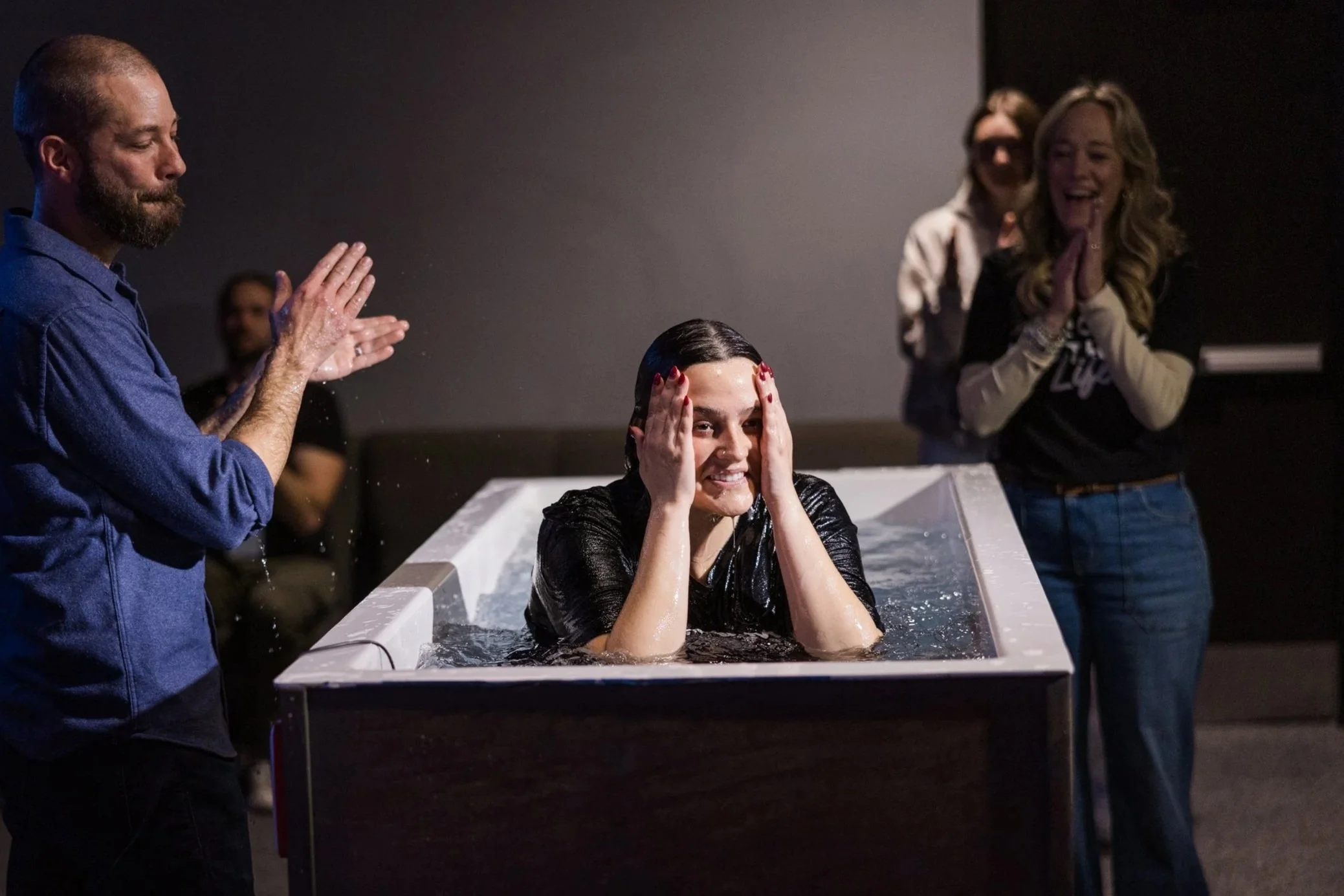
The girl who once feared that God might forget her stepped into the water to publicly declare what had been true all along: she belonged to Him. Not because she was good enough, or had somehow earned His love, but because Jesus had held onto her through every season of striving, doubt, fear, and healing. "This was the first time that I was professing my faith publicly."
The image of Trina's baptism captures the heart of her story. The child who carried responsibilities she was never meant to bear. The young woman who wondered if she could ever be good enough. The adult who spent years trying to control what could never truly be controlled. Standing in the waters of baptism with open hands, receiving the grace and love that had pursued her all along.
An Invitation to Receive Grace
Trina’s story holds an invitation for all of us. To stop exhausting ourselves trying to be good enough. To release the illusion that everything depends on us. To trust that the God who saves us also sustains us. Because grace was never something we had to achieve. It was always something we were invited to receive. And perhaps the miracle is not that God waited until we had it all together; it's that He met us right in the middle of our striving and gently whispered what has been true all along.
“You don't have to earn My love. You already have it.”
Baptism did not mark the end of Trina's story. It marked another faithful step in it. If God has been stirring something in your own heart, perhaps your next step is to say “yes”. If you are interested in learning more about baptism, we'd love to walk alongside you. Let us know here!
